


Shopping Cart
- Team Powair6
- Guides
- 0 likes
- 62 views
- 0 comments
When the first autumn games come around, gas replicas start behaving differently: the BB leaves the barrel slower, the slide cycles sluggishly, and the magazine empties faster than in summer. Choosing between gas or CO2 in airsoft then comes down to another question: what still works when the temperature drops? It depends on the replica. A GBB pistol, a GBBR and a sniper rifle are not set up the same way, and HPA offers a way out for each of them.
Why gas loses power in cold weather
Airsoft gas is sensitive to the outside temperature. The pressure printed on the can, in PSI, only holds at around 20 to 25 °C (68 to 77 °F): above that it rises, below it drops. A gas sold as 150 PSI is not 150 PSI in November. Below 10 °C (50 °F), it clearly loses power: it pushes less, the BB leaves slower and the slide recoil weakens.
A second effect adds up during play: cooldown. Every shot, the expanding gas cools the magazine. With repeated shots, the magazine gets colder and colder and power drops further, even in mild weather. In the cold, both effects stack up.
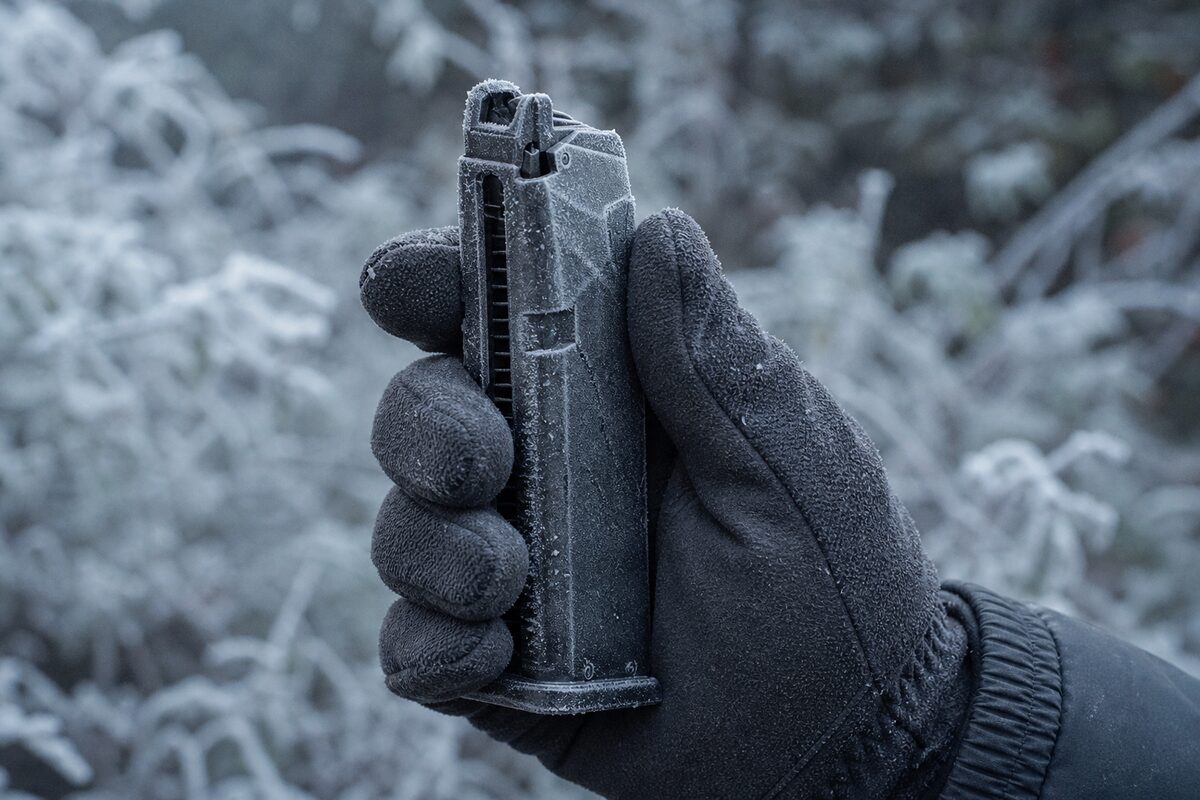
Switching gas only solves part of the problem. Gases range from about 100 to 200 PSI: the higher the pressure, the faster the BB leaves. A stronger gas partly makes up for the loss caused by the cold, but cooldown stays the same.
Gas power must also suit the replica. Gases around 110 PSI suit fragile mechanisms, such as Tokyo Marui pistols with a polymer slide. Gases from 180 to 200 PSI are made for low temperatures and replicas with strong internals. In between, we recommend 140 to 150 PSI: most replicas handle it, and its variations with temperature do not damage them. If your replica's product page says nothing, ask us before stepping up the power for winter.
CO2: less sensitive to cold air, but not without trade-offs
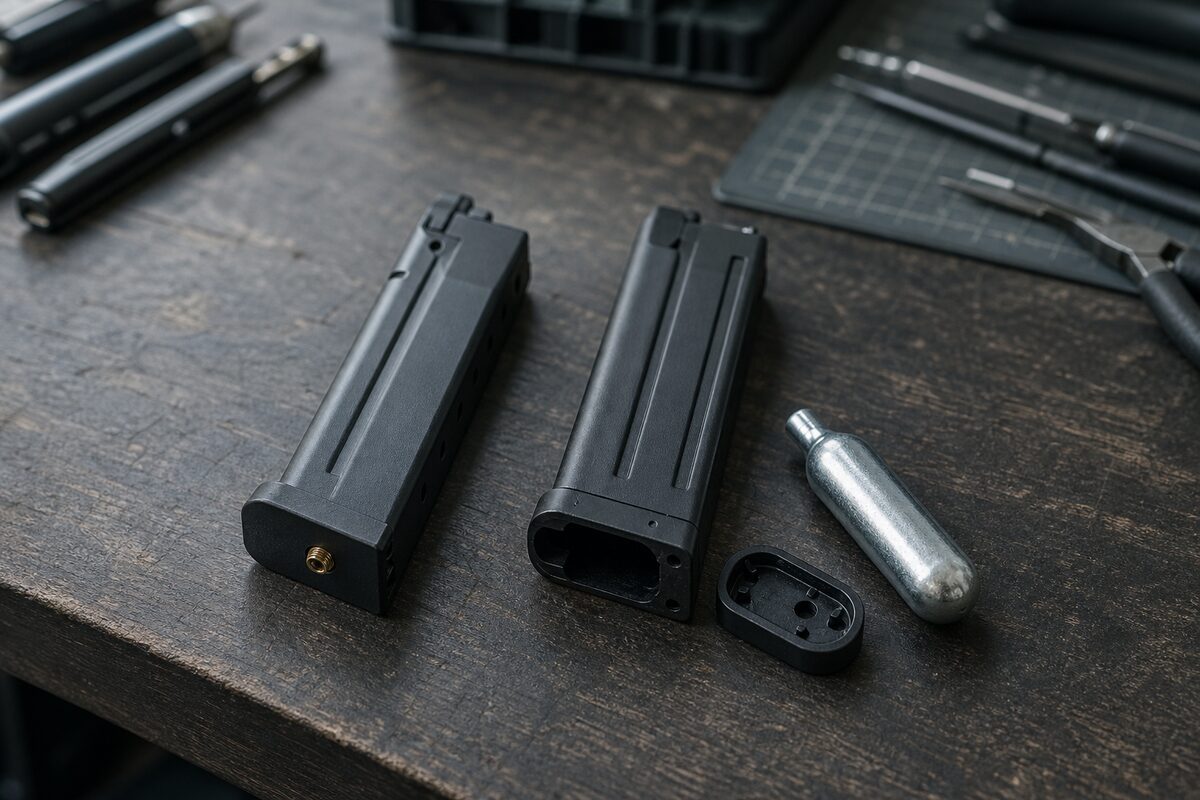
CO2 works differently. It is stored in cartridges, CO2 capsules, and it is generally much more powerful than gas. Its main advantage: it is barely affected by changes in outside temperature. That is why it is often recommended for winter. Yet it remains less common than gas: its power is harder to control, it quickly exceeds the limits allowed on fields, and its disposable capsules cost more in use.
But CO2 creates its own cold. With every shot, it switches abruptly from liquid to gas. Fire ten or fifteen shots in a row and it cools very quickly and loses power: it performs best in single shots, spaced out. This expansion also causes an intense freezing effect that dries out, stiffens and weakens the seals. Since CO2 contains no lubricant, the seals dry out even faster: a CO2 replica needs much more regular maintenance, with silicone oil on the magazine seals.
One more thing to know before choosing: magazine leaks are the leading cause of after-sales returns on handguns. On a gas magazine, the repair is simple. On a CO2 magazine, it is much more complex.
On a pistol, the magazine is what changes
On most GBB pistols, switching from gas to CO2 does not mean changing replicas: the magazine is what changes. The same pistol can often run with a gas magazine or a CO2 magazine. For winter, a CO2 magazine compatible with your model is a simple option, as long as you accept the higher power and the seal maintenance.
GBBR in winter: not your best ally
On a GBBR, the question is different. CO2 magazines for GBBRs have almost disappeared from the market: CO2 is therefore not a realistic option for long gas replicas.
When it is cold, the GBBR is not the most comfortable replica. A stronger gas partly makes up for it, within what the replica can handle, but cooldown remains. The only real way to play a GBBR all year round is an HPA conversion.
HPA: the propulsion that does not depend on temperature
HPA runs on compressed air, stored in a tank and brought down to the right pressure by a regulator. Unlike gas, it does not depend on temperature: power stays the same in November as in July. Compared with gas, this is also what gives it better shot-to-shot consistency.
For gas replicas, the conversion goes through the magazine:
- on a GBBR, magazines converted to HPA by 6LABS replace the gas magazines. Blowback is kept: the bolt still cycles with every shot;
- on a pistol, the conversion also goes through the magazine, with a valve that requires no drilling. There are also factory HPA handguns, which are rarer.
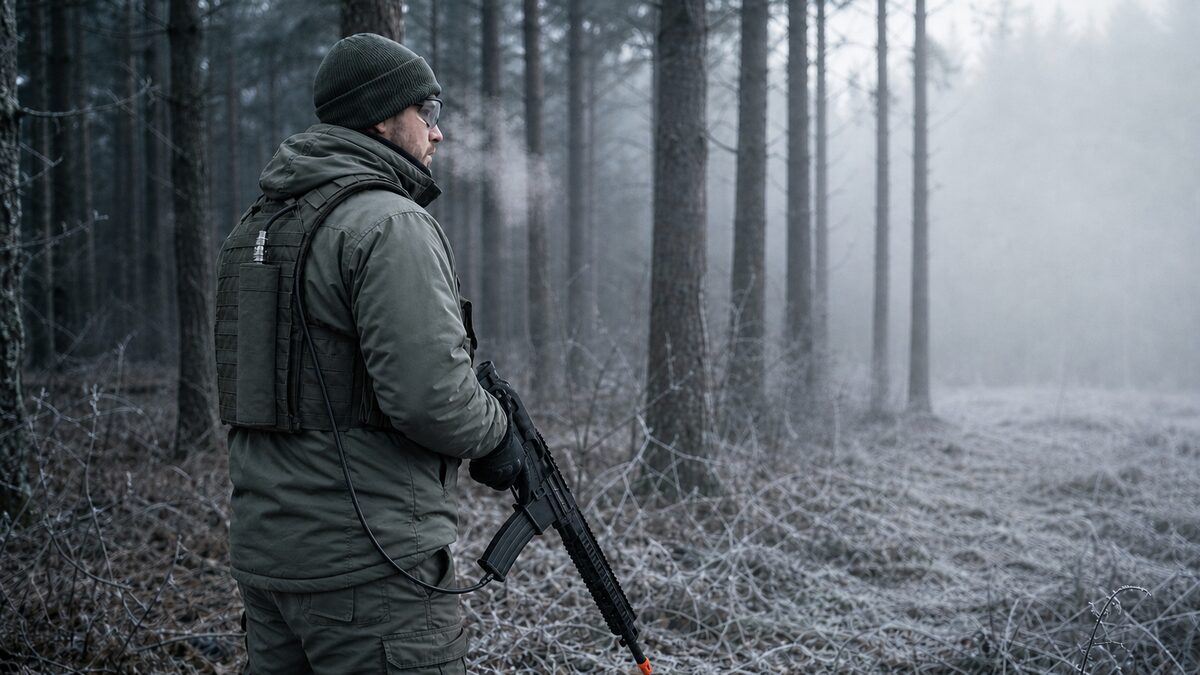
HPA has its trade-off: a tank to carry and a line running to the replica. Some kits do away with it, using a small 0.2 l tank or regulated CO2 mounted directly on the replica. CO2 alone is not HPA, but as soon as a regulator controls its pressure, it becomes HPA. This is how many sniper players use 12 g CO2 capsules with their HPA system.
To go further, our complete guide to HPA covers how it works, its components and conversion. Regulators, engines and accessories are grouped in HPA systems.
Gas, CO2 or HPA in the cold: comparison
| Gas | CO2 | HPA | |
|---|---|---|---|
| Sensitivity to cold air | High: loss of power below 10 °C (50 °F) | Low | None |
| Effect of its own expansion | Cooldown with repeated shots | Loss of power after 10 to 15 shots in a row, freezing effect on seals | Power set by the regulator |
| Power | Depends on the gas (about 100 to 200 PSI) | Generally much higher than gas | Adjustable at the regulator |
| Maintenance | Magazine seals, leaks easy to repair | Seals to lubricate often, leaks complex to repair | Less demanding than CO2 |
| Replicas concerned | GBB pistols, GBBRs, sniper rifles | Mostly pistols | Converted GBBRs and pistols, sniper rifles, converted AEGs |
| Trade-off | Power varies with the season | Seals to keep an eye on | Tank and line (except built-in kits) |
Playing gas replicas in the cold: good habits
- In cold weather, keep your magazines warm until it is time to play, for example close to your body rather than in a bag.
- Space out your shots: with rapid fire, cooldown adds to the cold and power drops faster.
- Choose a gas suited to your replica, without exceeding what the slide can handle.
- Bring a spare magazine: one magazine is never enough in a game, even less so when it needs to warm up.
- Watch the seals: that is where leaks happen, especially in cold weather.
- Play with dry gas, store with silicone gas: between two airsoft days, leave a little silicone gas in your magazines to keep them under slight pressure and lubricate the seals.
Powair6 expertise
To choose the right gas for your replica, switch a pistol to CO2 or convert a GBBR to HPA before winter, contact our team. Our 6LABS workshop handles conversions.
Comments (0)