


Shopping Cart
- Team Powair6
- Guides
- 7 likes
- 2313 views
- 1 comments
Let's bust a myth right away: no, HPA is not "more consistent" than an AEG. It's an idea repeated everywhere, including by retailers, but it's simply wrong. An HPA engine installed in an AEG delivers the same FPS consistency as the AEG itself. So why switch to HPA?
The answer depends on what you're running right now.
Playing with an AEG? HPA gives you what your electric motor can't: field-proven reliability, trigger responsiveness (the time between pulling the trigger and the BB leaving the barrel is much shorter), quieter operation, and easy adjustments. Want to drop from 2 joules to 1 joule between games? One twist of the regulator dial, done. No need to crack open the gearbox to swap a spring. And above all, HPA doesn't break down: fewer moving parts, fewer failures, fewer trips to the workshop. An HPA engine can handle over a million shots.
Playing with a GBBR? You love the recoil, the weight of a metal magazine, the realistic feel. The problem is that gas gives up on you as soon as the temperature drops. Playing year-round with consistent performance? Not happening. HPA solves this: compressed air doesn't depend on temperature. You keep the blowback, you keep the feel, but you're shooting at the same power in January and July. This, and only this, is where the HPA consistency argument holds true: against gas, not against AEG.
At its core, HPA is a principle: regulated air. Any system with an air regulator is HPA, whether it's an engine in a gearbox or a GBBR magazine converted to run on compressed air.
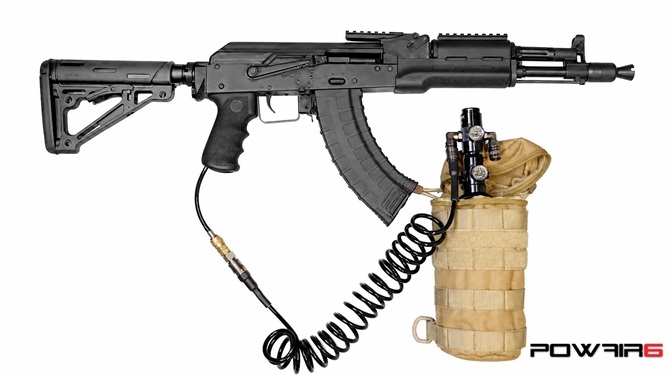
This guide covers everything you need to know before going HPA: how it works, what it really costs, which engine to pick, and how to convert your replica. No marketing fluff. Just workshop experience and field data.
What is HPA in airsoft?
HPA stands for High Pressure Air. It's a propulsion system that replaces your replica's internals (AEG electric motor or GBB gas) with compressed air fed from an external tank.
When you pull the trigger, a solenoid valve or pneumatic mechanism releases a measured dose of air that propels the BB. The result: near-instant trigger response, quieter operation than an AEG, and power adjustable with a single twist of the regulator, without opening the gearbox.
Two families of HPA engines
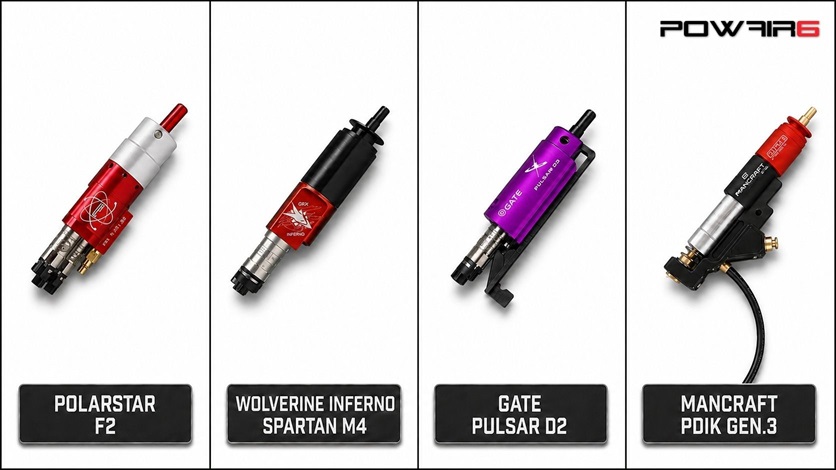
Solenoid engines (PolarStar F2, Wolverine Inferno, Gate Pulsar) use a solenoid valve controlled by an electronic board (FCU, Fire Control Unit). They need a battery. In return, they offer full control: rate of fire, dwell (solenoid open time), fire modes. A key advantage: rate of fire is adjustable in a few clicks on the FCU, up to 40 rounds per second. Some AEGs can hit 50 or even 60 rounds per second, but at those rates the mechanical parts (gears, pistons) won't last long. HPA handles those rates without the same mechanical stress. That's what makes it the go-to system in speedsoft, where every millisecond of responsiveness counts.
Mechanical engines (Mancraft PDiK, PolarStar Kythera) run with no battery or electronics. The system is purely pneumatic: lightweight striker mechanisms actuate a valve to release the air. Simpler, more reliable, semi-auto in most cases, although some mechanical systems now support full-auto. Rate of fire remains limited by the mechanical cycling.
HPA vs AEG vs GBBR (and CO2): a field comparison
The real question isn't "which system is the best." It's "which system matches the way you play."
Performance and consistency
| Criteria | AEG (standard) | HPA | GBBR |
|---|---|---|---|
| FPS consistency | Good (5-10 FPS variation on a well-built AEG) | Good (5-10 FPS variation, same level as an AEG) | Variable (depends on temperature and gas type) |
| Trigger response | Noticeable motor delay (improvable with MOSFET, brushless, electronic trigger) | Instant (solenoid) / Better than stock AEG (mechanical) | Instant |
| Rate of fire | Lower than HPA on a stock AEG | Adjustable from 5 to 50-70 rounds/s via FCU (solenoid), sustainable long-term | Limited by the blowback's mechanical cycle |
| Field reliability | ★★★★☆ Mechanical parts under stress | ★★★★★ Very few moving parts | ★★★½☆ O-rings, magazines, temperature sensitivity |
| Maintenance frequency | Moderate | Infrequent | Regular |
| Noise level | Standard | Quieter | Variable (blowback is loud) |
| Power adjustment | Spring swap (requires opening the gearbox) | One twist of the regulator dial | Adjustable via NPAS or by switching gas type |
What about range? Contrary to popular belief, effective range is identical across AEG, HPA, and GBBR at equal power. It depends solely on the weight-to-velocity ratio of the BB (BB weight and joules). The propulsion system has zero impact. That's why we don't include it in this comparison.
And HPA vs GBBR consistency? This is where the difference is clear-cut. Converting a GBBR to HPA eliminates the dependency on temperature: same performance in January as in July.
In-game feel
The AEG is the standard: reliable, versatile, quiet. HPA keeps that versatility and adds responsiveness and consistency. The GBBR offers realism (blowback, metal magazine weight, recoil) at the cost of endurance and cold sensitivity.
Where does CO2 fit in?
CO2 and HPA both use pressurized air, but the comparison ends there. CO2 runs on disposable cartridges (12 g or 33 g), at a fixed pressure (~850 PSI), with no power adjustment. HPA relies on a refillable tank, adjustable pressure, and zero temperature sensitivity.
The components of an HPA setup
The tank
| Size | Use case | Best for |
|---|---|---|
| 0.2 L | CQB, Speedsoft, low profile | Lightweight CQB player |
| 0.4 L | Compact all-rounder | Regular player |
| 0.8 L | Standard | Most players |
| 1.1 L | High BB output | Support gunners |
Tank life depends directly on the output pressure set on your regulator. A regulator set to 50 PSI uses roughly three times less air than one set to 150 PSI. Think of it like a car on a track: drive smooth and the tank lasts all day; floor it and you'll be refilling fast. With HPA, the higher the pressure, the shorter the tank life.
The preset and the regulator
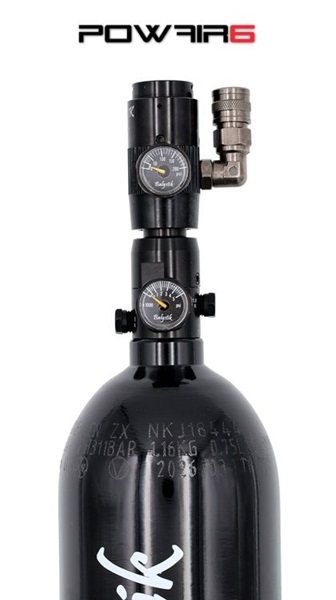
The system works in two stages. The preset, screwed onto the tank, drops pressure from 3,000 PSI down to 800 PSI (a fixed pressure inherited from paintball). The adjustable regulator, mounted above the preset, converts those 800 PSI into 0 to 200 PSI that you dial in based on the power you need.
EU vs US fittings: the #1 trap
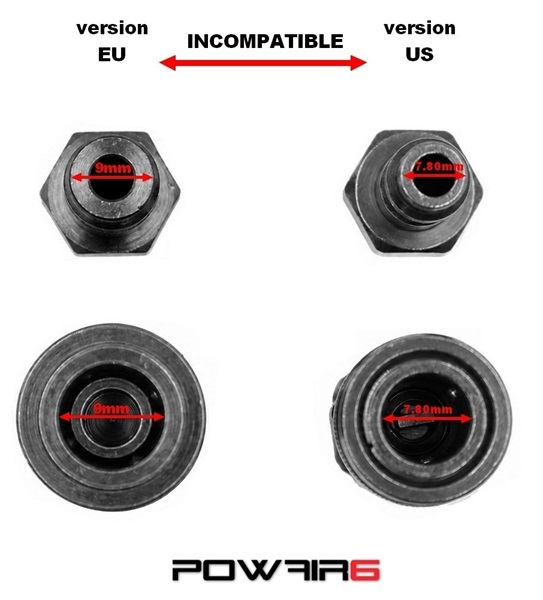
This is the single biggest source of confusion and support calls. Two incompatible standards: EU (larger thread) and US (1/8 NPT). Mix them up and you're guaranteed a leak.
Which HPA engine should you choose?
Four major players on the HPA systems market. Here's what each one does best.
PolarStar F2
A miniaturized Fusion Engine. Dual solenoid, programmable FCU, compatible with V2 and V3. It's the engine with the most tuning options. Another strong point: every part is available individually. If a component fails, you can replace just that piece without buying the whole engine.
Wolverine Inferno Gen 2
The easiest engine to install. Single solenoid, settings via Spartan or Premium FCU (optional BLINC Bluetooth upgrade). Like the F2, every part is available individually: maximum repairability.
Gate Pulsar
Available in D (dual solenoid) and S (single solenoid) versions. Pairs with the TITAN II Bluetooth FCU (sold separately or as a set). Fits right into the Gate ecosystem (GCS app).
Mancraft PDiK
A purely mechanical system. No battery, no FCU. Semi-auto only. Simple and reliable.
Mancraft appeals to two types of players. Those who want HPA on an unusual replica (models that PolarStar and Wolverine don't cover). And more importantly, players looking for high power: the PDiK, with no electronics or software-imposed limits, is especially well suited for high-power builds (DMR, HPA sniper).
6Labs workshop insight
Right now, the Inferno Gen 2 is the engine we install the most in the workshop. It seems to be the most popular choice among players.
6Labs workshop insight
Whichever engine you pick, reliability is the common thread across all HPA systems. And to show just how far that goes, PolarStar proved it in the most extreme way possible.
1 million shots at 45 rounds per second
Even with the earliest HPA systems, reliability was already a recognized strength. Today's engines push it further, but the most striking example comes from a previous generation. PolarStar put its Fusion Engine through an extreme endurance test: continuous full-auto at 45 rounds per second, trigger held down with a zip tie, fed directly from a shop compressor. The goal: hit 1 million shots with no interruptions and no part replacements. That's what happens when you remove the gears, the piston, and the spring from a gearbox: there's nothing left to break.
If an engine that's barely sold anymore could already handle that, today's systems have only gotten better. That's also what the HPA reliability argument is about.
How to convert your replica to HPA
Converting an AEG (V2 or V3 gearbox)
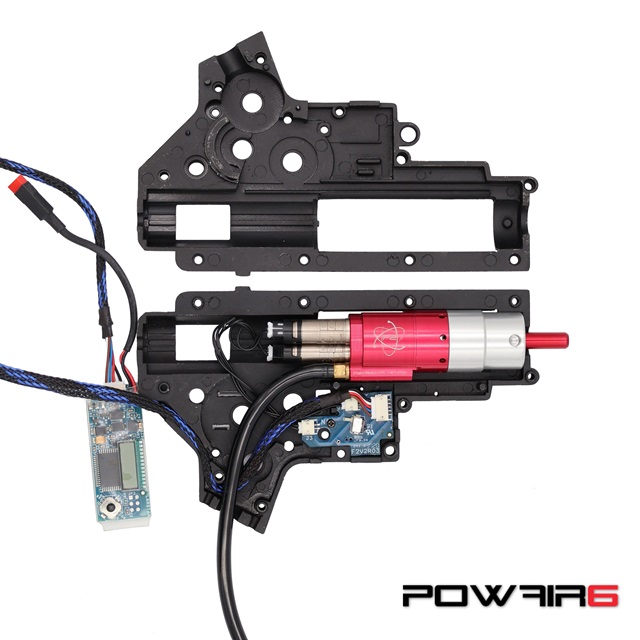
- Open the gearbox and remove the cylinder, piston, spring, electric motor, and gears
- Install the HPA engine in place of the cylinder
- Connect the trigger board included with the HPA engine
- Route the HPA line through the stock or grip
- Set the output pressure on the regulator
- Test and run it over the chrono to check consistency
Installation time
At the 6Lab workshop, a PolarStar F2 or Wolverine Inferno Gen 2 on a clean V2 gearbox takes under an hour to install, then at least 30 minutes of test firing and tuning, so about 1h30 total with no surprises (it can take longer depending on the case). For someone doing it at home without experience, expect it to take considerably longer, with the risk of irreversible damage to parts.
Converting a GBB/GBBR
Two methods: a no-drill valve (replaces the gas valve in the magazine, reversible in 30 seconds) or an M4 HPA adapter (replaces the magazine, compatible with Hi-Capa, Glock, AAP-01).
Heads up: the no-drill valve works with about 70% of GBB and GBBR magazines. For the remaining 30%, machining is required (drilling and tapping the magazine to fit the valve). That's workshop work, and 6Lab offers this service.
In both cases, no internal modifications to the replica: it's the magazine that gets converted to run on compressed air. You keep the blowback and the GBBR feel, without the gas temperature dependency.
Why trust the install to a workshop?
A poorly installed HPA system can cause sidespin (BBs veering sideways), shotgun-like spread (10-15 cm dispersion between shots), misfeed (BBs not feeding properly), or simply no shots at all. These aren't malfunctions: they're the result of incorrect setup. The 6Lab workshop has been building and tuning HPA systems for 15 years.
The install is half the job. The tuning is the other half.
Ready-to-play HPA replicas
Don't feel like converting your replica? There are models designed natively for HPA, ready to play right out of the box.
The Wolverine MTW (Billet and Forged Series) is currently the best seller in this category. The price is competitive, the quality is there, and maintenance is minimal. You plug in your line, set your pressure, and play. No conversion, no gearbox to open. The Scorpion is another option for those looking for a plug-and-play HPA replica.
One thing to consider: with a factory replica, you'll have the same model as many other players. If you want to stand out on the field with a unique setup, converting a replica of your choice is the way to go.
HPA budget: what does it really cost?
HPA has a reputation for being expensive. That's true upfront. It's wrong over 2 years.
The entry cost
| Component | € | €€ | €€€ |
|---|---|---|---|
| HPA engine | Starting at 250 € (Kythera, PDiK, Storm) | 300-380 € (Gate Pulsar, Mancraft) | 380-500 €+ (Wolverine Inferno, PolarStar F2, Fusion Engine) |
| Regulator | Balystik HPR200: best value on the market | Mini SFR (very popular among players) | Grip MSG |
| 0.8 L tank | 55-60 € (aluminum) | 150-250 € (Kevlar) | |
| Line + fittings | 20-30 € (Balystik) | 30-40 € (Wolverine) | |
| Total system | Around 500 € | Around 600 € | Around 900 € |
Note: all prices exclude the replica itself. For the line and fittings, no product makes a difference in terms of performance: the choice is purely about budget.
The budget depends on your starting point. Converting a GBBR? A valve, a line, a tank, and a regulator: expect around 160 €. No HPA engine needed, it's the magazine that gets converted.
Converting an AEG? You'll need the HPA system (engine), the tank, the line, and the regulator: starting at 400 € excluding the replica. The budget goes up depending on the engine you choose (see the table above).
Here's one of HPA's surprises: a GBBR conversion is significantly cheaper than an AEG conversion, because you're not replacing the replica's internal mechanics.
6Labs workshop insight
Tuning, maintenance, and field use
Adjusting power (FPS)
Power is adjusted via the regulator's output pressure. One twist of the dial takes you from 2 joules to 1 joule, without opening the gearbox or swapping a spring. There's no point listing PSI-to-FPS tables: too many variables come into play (barrel length, inner diameter, hop-up bucking, BB weight). Every setup is different. The right approach: dial it in on the chrono at the field.
Maintenance
Maintaining an HPA setup depends on how much you use it. There's no fixed schedule. The principle: check the O-rings, apply a dab of HPA grease if needed, inspect the line. It's less maintenance than an AEG, and it's faster too: fewer parts to disassemble, reassemble, and adjust. On an AEG, maintenance and repairs take longer because of the gearbox's mechanical complexity.
HPA on the field
Let's be honest: HPA isn't always welcome at airsoft fields. Two things tend to make organizers uneasy. First, the ability to crank up the pressure between games (even though some regulators can be locked). Second, trigger responsiveness: on a semi-auto-only field, an HPA player can pull fast enough to effectively simulate full-auto. Many fields are cautious about it, but attitudes are shifting in the right direction as more and more players run HPA.
In France, the legal cap is 1.99J (above this, a replica is classified as a Category D weapon). Other European countries have different limits: 1J in Italy and Germany, for example.
The advantage for European players: every country has its own limit (1.99J in France, 1J in Italy, 1J in Germany). With an AEG, you're stuck at factory power. With HPA, one twist of the dial is all it takes to match the legal limit wherever you're playing. Example: an Italian player wants to run a 416 VFC, but no model exists limited to 1 joule. An HPA system lets them use the replica they want at their country's legal power.
Tank refills: equipped fields, dive shops, a personal compressor (300-400 €), or a hand pump (60-100 €).
Comments (1)