


Shopping Cart
- Team Powair6
- Guides
- 0 likes
- 38 views
- 0 comments
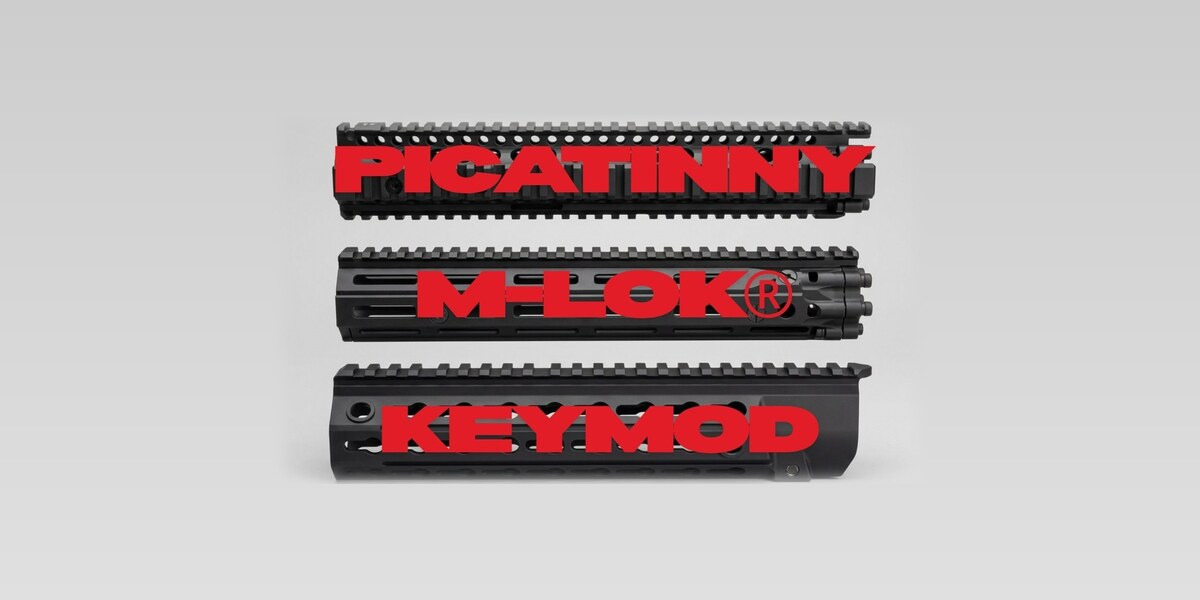
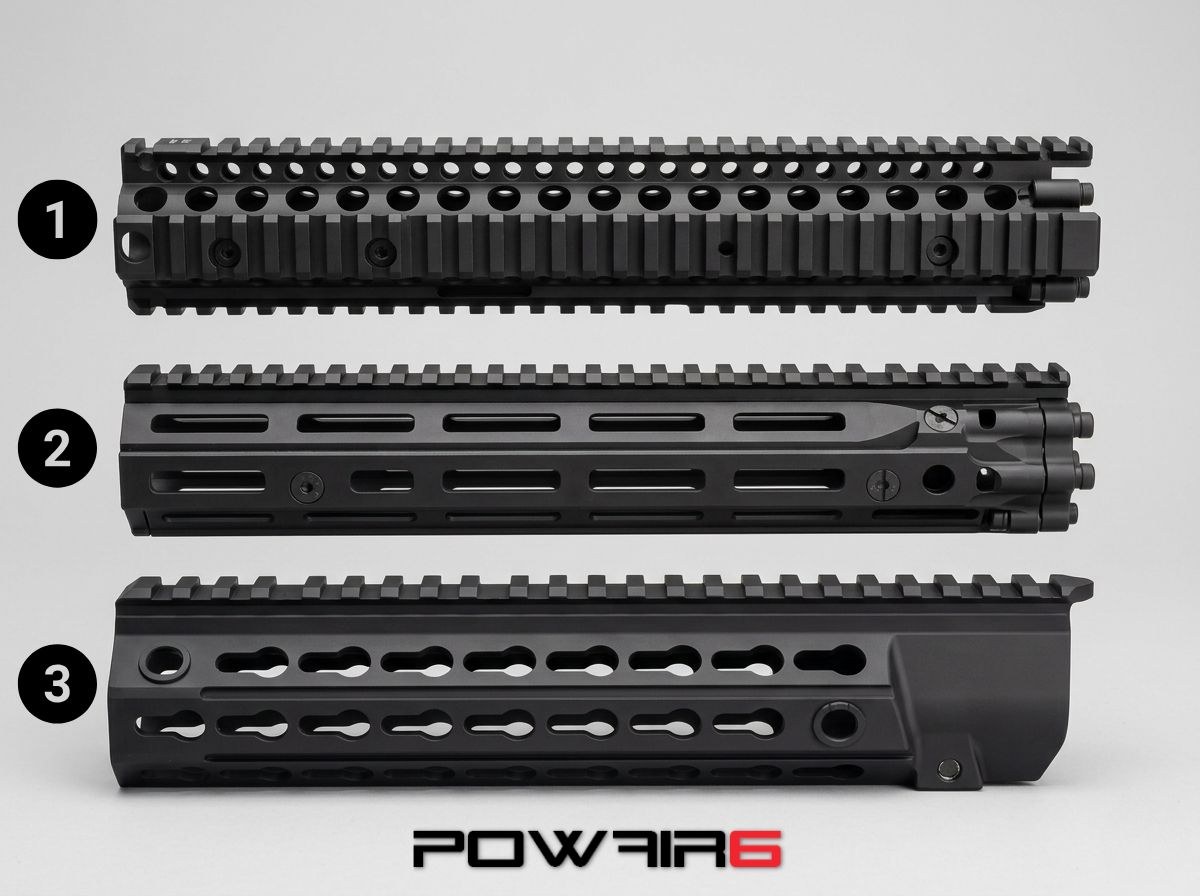
A red dot, a flashlight, a foregrip or a bipod can only be mounted on a replica if its mount matches the one on the replica. In airsoft, three systems coexist: the Picatinny rail (1), M-LOK® (2) and KeyMod (3). They are not cross-compatible: a KeyMod accessory will not fit an M-LOK® handguard, and vice versa. Note that in the photo, a Picatinny rail also runs along the top of the M-LOK® (2) and KeyMod (3) handguards. Before buying an accessory, you therefore need to know which system your replica uses.
Picatinny rail: the airsoft mounting standard
The Picatinny rail is the original system: a slotted rail defined by the US military standard MIL-STD-1913, adopted by the US Army in 1995. Today, any manufacturer can produce it, and it is found everywhere, from real firearms to replicas. This is what sets it apart from M-LOK®, whose use requires a Magpul licence.
In airsoft, a rail always means a Picatinny rail. It is found in two places:
- on the upper, the top part of the replica's body, where the scope and red dot are mounted;
- on the handguard, around the outer barrel, for flashlights, foregrips, lasers and bipods.
Picatinny rail dimensions
The standard sets the rail profile to within a few hundredths of a millimetre, so a Picatinny accessory fits any rail that meets the standard. The two dimensions to remember:
- slot width: 0.206 inch, or 5.23 mm;
- slot spacing: 0.394 inch, or about 10 mm from one slot to the next.
On product pages, rail length is counted in slots: a 7-slot rail has seven. The number of slots an accessory takes up depends on its base and is listed on its product page.
Weaver rail or Picatinny rail: compatible one way only
The Weaver rail looks like the Picatinny, but its slots are narrower (0.180 inch, or 4.57 mm) and their spacing is not standardised. In practice:
- an accessory designed for Weaver will generally fit a Picatinny rail;
- a Picatinny accessory will not always fit a Weaver rail, because its recoil bar may be too wide for the slots.
In airsoft, Picatinny is by far the most common.
Handguard, RIS, RAS: the same part
Handguard, RIS and RAS all refer to one and the same part: the one that surrounds the outer barrel and that your hand holds. It carries the accessories and provides a grip, just like on a real firearm, where it also protects from barrel heat.
Many players choose their replica primarily for its handguard. Those who change it do so for four reasons:
- length, depending on play style and build: short for CQB (7 to 10 inches), long for a DMR (14 inches);
- looks, the most common reason;
- the mounting system, to switch from Picatinny to M-LOK® or the other way round;
- ergonomics: thickness, profile, weight, grip comfort.
Changing a handguard is not always simple: it attaches to the replica's barrel nut, which differs between AEG and GBBR. Before buying, check compatibility with your model.
There are three types of handguards, depending on their system: Picatinny handguards, M-LOK® handguards and KeyMod handguards.
M-LOK® and KeyMod: slotted handguards
A Picatinny handguard carries rails along its entire length, often on all four sides. Modular systems do the opposite: the handguard is smooth and slotted, and an accessory or rail section is added only where it is needed. The handguard becomes slimmer and lighter, and is more comfortable to hold bare-handed.
KeyMod: the first modular system
KeyMod gets its name from the keyhole shape of its slots ("key") and its modular principle ("mod"). Designed by the American manufacturer VLTOR, it was released in 2012 as an open standard: any manufacturer could adopt it.
M-LOK®: today's modular standard
M-LOK® ("Modular Lock") is a system developed by Magpul and released in 2014. It is a registered trademark of Magpul, which grants its licence free of charge but subject to approval. Its slots are oblong and accessories attach directly to them, without going through a rail.
Why M-LOK® replaced KeyMod
In a report published in 2017, the US Navy test centre (NSWC Crane) compared the two systems for US Special Operations Command: M-LOK® clearly outperformed KeyMod in repeatability (the accessory returns to the same position after removal), drop resistance and failure load. US special forces then selected M-LOK® handguards, and manufacturers followed.
A replica fitted with a KeyMod handguard remains perfectly usable. The choice of accessories is simply narrower, and M-LOK® is now the dominant modular standard.
Picatinny, Weaver, KeyMod, M-LOK®: comparison table
| Picatinny | Weaver | KeyMod | M-LOK® | |
|---|---|---|---|---|
| Principle | Slotted rail | Slotted rail | Keyhole slots | Oblong slots |
| Standard / origin | MIL-STD-1913 (1995) | Earlier civilian standard, spacing not standardised | VLTOR, 2012, open standard | Magpul, 2014, registered trademark |
| Mounting an accessory | Directly on the rail | Directly on the rail | Via a rail section or a KeyMod accessory | Directly, or via a Picatinny rail section |
| Compatible with | Picatinny accessories and most Weaver ones | Weaver accessories | KeyMod accessories only | M-LOK® accessories only |
| In airsoft today | Everywhere (upper, handguard) | Rare | Declining | Dominant modular standard |
Adding a Picatinny rail to an M-LOK® or KeyMod handguard
There is no such thing as an "M-LOK rail". What shops call by that name is a Picatinny rail section with M-LOK® mounting: a piece of rail that screws into the handguard slots. The same goes for KeyMod. This lets you mount a Picatinny accessory (red dot, flashlight, laser) on a modular handguard, exactly where and over the length you want.
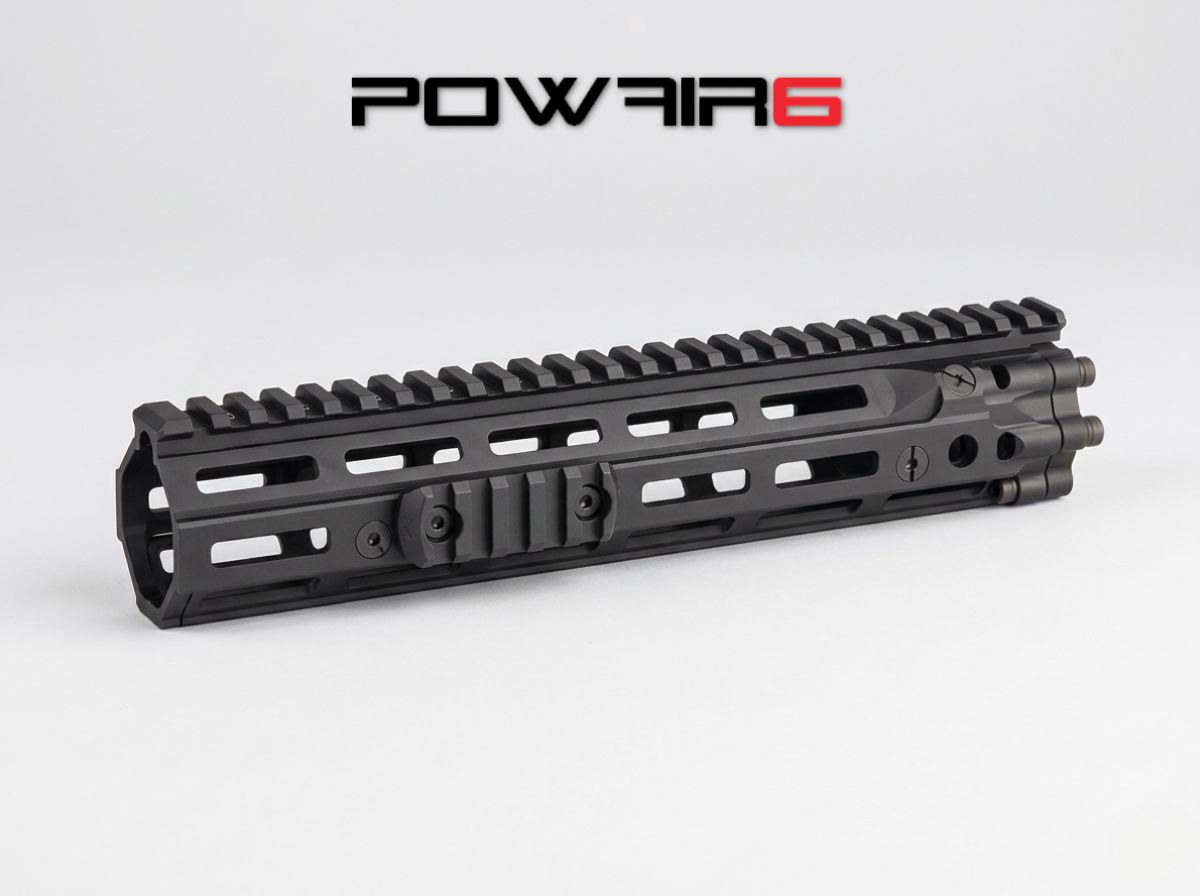
To mount a rail section:
- Check your handguard's system: an M-LOK® section will not fit a KeyMod handguard, and vice versa.
- Choose the position and length according to the accessory: a few slots are enough for a flashlight, more for a foregrip or a bipod.
- Insert the screws and their nuts into the slots. On M-LOK®, the nut rotates a quarter turn to lock behind the slot.
- Tighten until the section no longer moves, without forcing on a polymer handguard.
In our catalogue, Picatinny rail sections for M-LOK® and KeyMod rails come in several lengths. On a Picatinny handguard, rail covers protect your hands from the slots where no accessory is mounted.
Which system should you choose for your replica?
The choice is rarely made from scratch: it depends first on your replica's handguard.
- For optics, the Picatinny rail on the upper remains the reference: red dots, scopes and risers are designed for it.
- For CQB and speedsoft, a short M-LOK® handguard keeps the replica light and slim, with only the accessories you need: a flashlight and a foregrip attach directly to the slots.
- For DMR, sniper or support roles, a long handguard takes the bipod, on a rail section or directly on M-LOK® depending on the model.
- On a KeyMod handguard, there is no need to replace it: KeyMod accessories and sections are still available.
- On a replica without a rail, such as some AKs, dedicated rails let you add one.
Pistol red dots, on the other hand, do not mount on a Picatinny rail but on an RMR plate specific to each model. All mounts are grouped in the rails and mounts category.
Powair6 expertise
To find out which system your replica uses, which accessory fits it or whether a handguard will fit your model, our team is available by phone at +33 5 34 27 88 10.
Comments (0)